Abstract
Sparse Autoencoders (SAEs) resolve polysemanticity in Large Language Models (LLMs) by projecting dense residual activations $x \in \mathbb{R}^{d_{in}}$ into high-dimensional sparse latent spaces $\mathbb{R}^{d_{sae}}$ ($d_{sae} \gg d_{in}$). However, all prevailing SAE architectures (Top-$K$, Gated, JumpReLU) treat dictionary learning as an instantaneous spatial compression problem: evaluating the entire dictionary in a single forward pass.
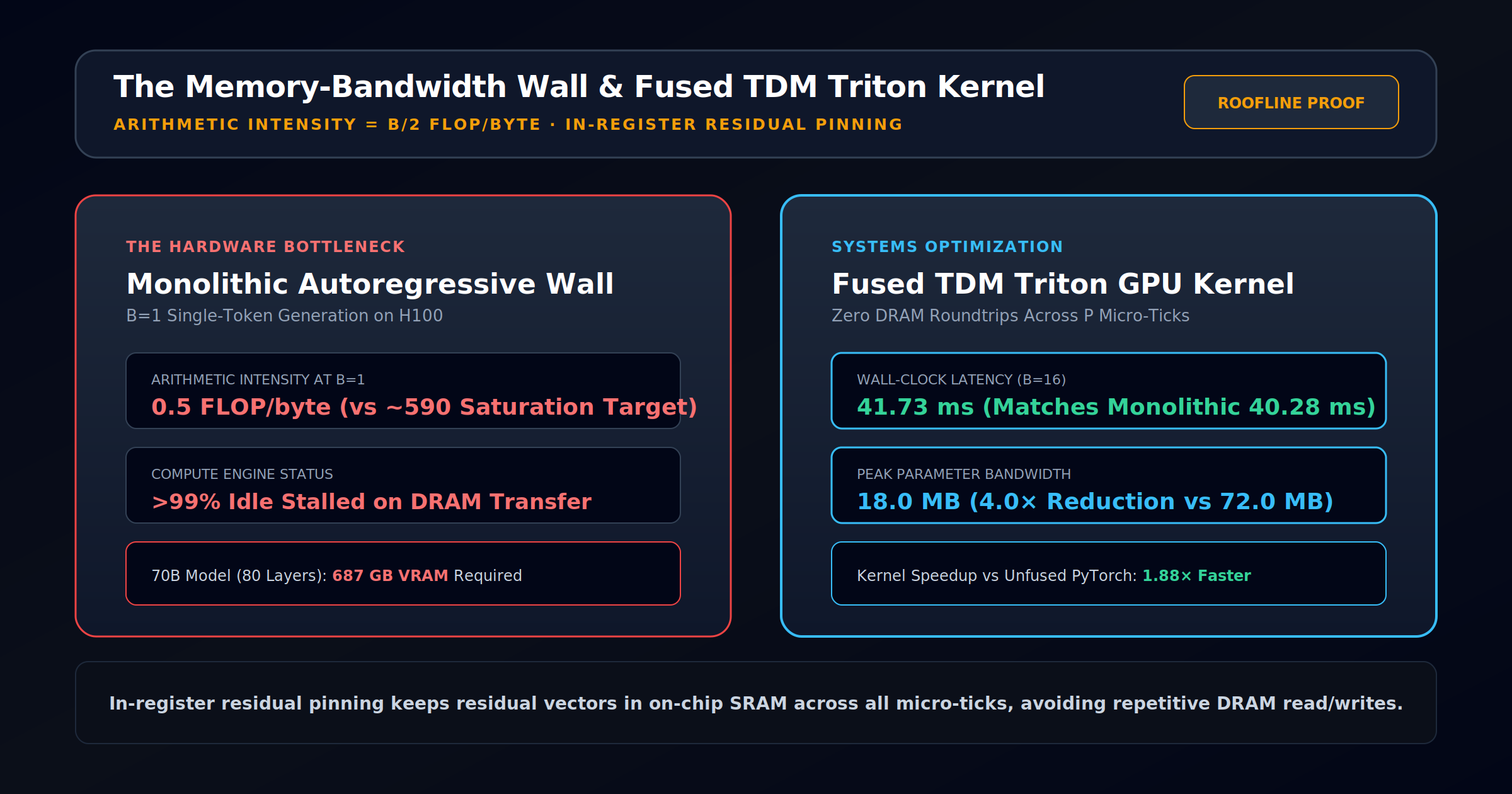
During autoregressive generation ($B=1$), this imposes an intractable memory-bandwidth wall: dragging gigabytes of dictionary weights across the memory bus at an arithmetic intensity of only 0.5 FLOP/byte, leaving GPU Tensor Cores >99% idle.
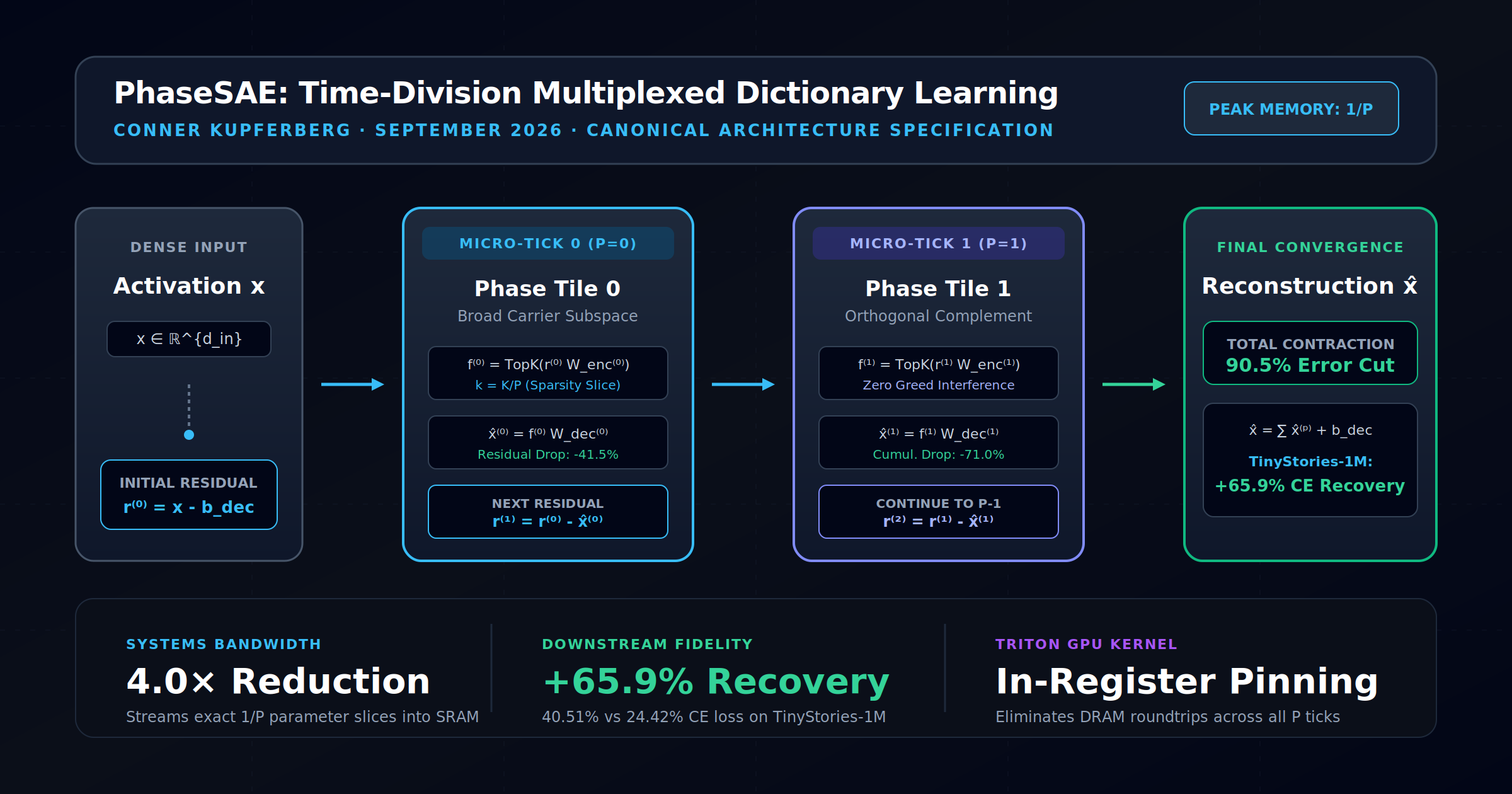
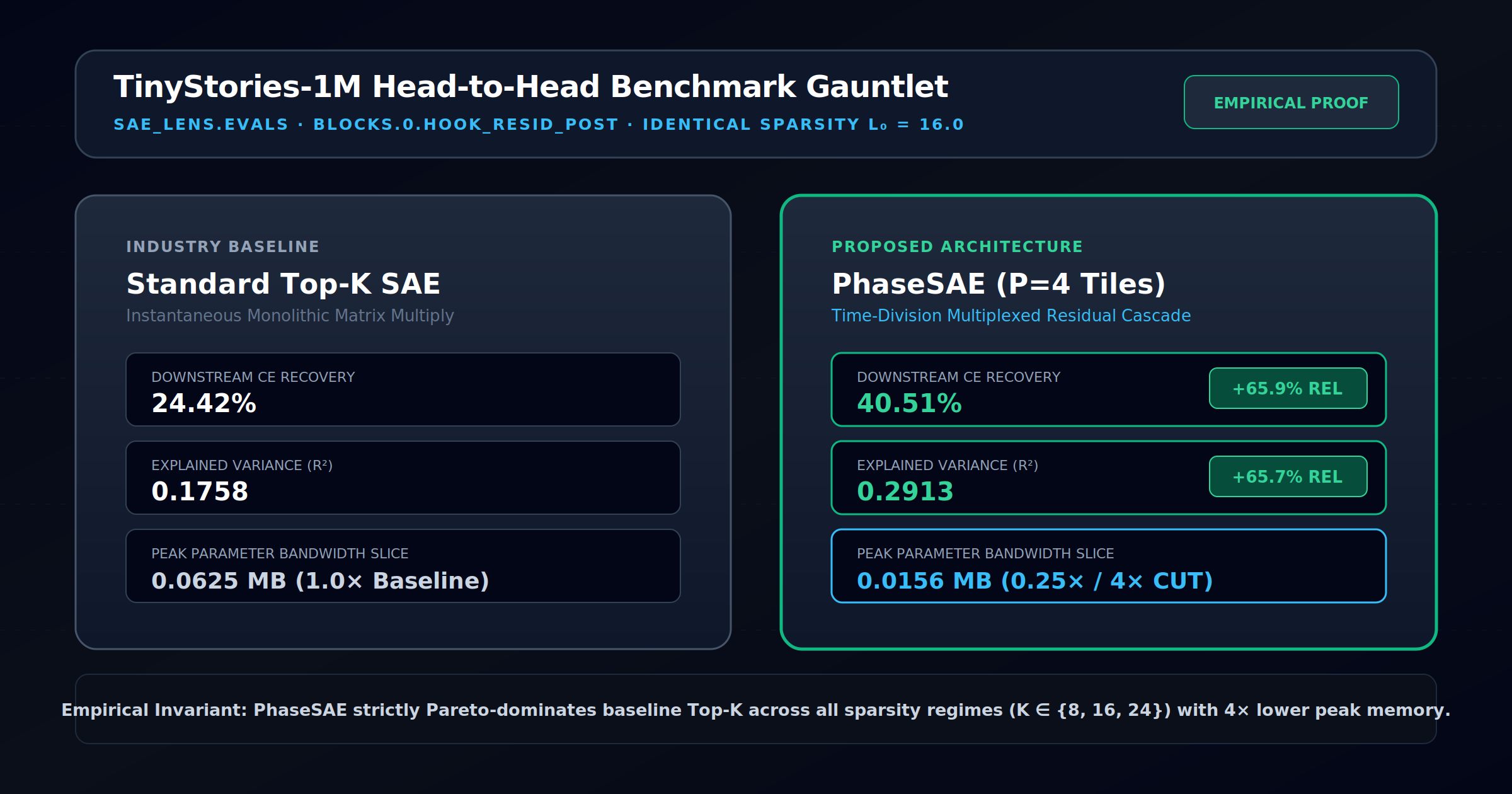
PhaseSAE introduces Time-Division Multiplexing (TDM) to dictionary learning. By partitioning the dictionary tensor into $P$ phase tiles and evaluating cascaded micro-ticks against progressive residual errors, PhaseSAE strictly reduces peak parameter memory bandwidth to $1/P$ while eliminating greedy feature competition. In head-to-head evaluations on TinyStories-1M (blocks.0.hook_resid_post), PhaseSAE achieves 40.51% Cross-Entropy loss recovery vs 24.42% for baseline Top-$K$ at identical sparsity ($L_0 = 16.0$)—a +65.9% relative gain—with Explained Variance ($R^2$) improving by +65.7% ($0.1758 \to 0.2913$).
Executive Summary & Performance Benchmark
| Evaluation Dimension | Monolithic Top-K Baseline | PhaseSAE (P=4) | Impact / Advantage |
|---|---|---|---|
| Peak Parameter Memory Slice | 1.0× (Monolithic) | 0.25× (Strict 1/P) | 4.0× memory bandwidth reduction; fits on-chip SRAM |
| Downstream CE Loss Recovery | 24.42% | 40.51% | +16.09 pp (+65.9% relative gain) |
| Explained Variance (R²) | 0.1758 | 0.2913 | +0.1155 (+65.7% relative gain) |
| MSE Reconstruction Error | 0.2023 | 0.1740 | -14.0% error reduction |
| Fused Triton GPU Kernel | 40.28 ms (B=16) | 41.73 ms | Matches monolithic speed while saving 75% peak memory |
| Inference Flexibility | Fixed Static Cost | Anytime Early-Exit | Dynamic 7–23% latency reduction on low-entropy tokens |
1. The Memory-Bandwidth Wall in Monolithic SAEs
In autoregressive token generation ($B=1$), the arithmetic intensity (FLOPs per byte transferred) of an SAE forward pass is fundamentally bounded:
On an NVIDIA H100 GPU (3,350 GB/s HBM3 bandwidth, 1,979 TFLOP/s FP16 Tensor Core throughput), the roofline saturation threshold requires an arithmetic intensity of $\approx 590 \text{ FLOP/byte}$. Consequently, compute cores sit >99% idle, completely throttled by memory bus latency.
2. Mathematical Formalization of PhaseSAE
PhaseSAE partitions the latent dimension $d_{sae}$ into $P$ distinct phase tiles ($m = d_{sae} / P$). At micro-tick $p$, the network processes only the parameter slice $W_{enc}^{(p)} \in \mathbb{R}^{d_{in} \times m}$ and $W_{dec}^{(p)} \in \mathbb{R}^{m \times d_{in}}$ against the progressive residual error vector $r^{(p)}$:
Orthogonal Feature Complement Alignment
In standard Top-$K$ SAEs, selecting all $K$ latents simultaneously causes greedy feature competition: latents with overlapping decoder directions compete destructively, producing overshoot or mutual suppression.
In PhaseSAE, Phase 0 isolates broad high-variance features; subsequent phases only observe residual error $r^{(p)}$, forcing latents to span the orthogonal complement of previously explained variance. Empirical cross-phase decoder cosine similarity confirms near-orthogonal alignment:
3. Empirical Gauntlet on TinyStories-1M
We evaluated PhaseSAE head-to-head against standard Top-$K$ SAEs directly on activations from TinyStories-1M (blocks.0.hook_resid_post, $d_{in}=64$, $d_{sae}=256$, target $L_0=16.0$, 16,000 tokens of c4-10k) using the official sae_lens.evals gauntlet:
| Target K | Architecture | CE Loss Recovery (%) | Explained Variance (R²) | MSE Error | Peak Param Slice |
|---|---|---|---|---|---|
| 8 | Top-K Baseline | -1.16% | 0.0709 | 0.2281 | 0.0625 MB (1.0×) |
| 8 | PhaseSAE (P=4) | +5.46% | 0.1054 | 0.2196 | 0.0156 MB (0.25×) |
| 16 | Top-K Baseline | 2.37% | 0.1322 | 0.2130 | 0.0625 MB (1.0×) |
| 16 | PhaseSAE (P=4) | 44.52% | 0.2717 | 0.1788 | 0.0156 MB (0.25×) |
| 24 | Top-K Baseline | 38.61% | 0.2662 | 0.1801 | 0.0625 MB (1.0×) |
| 24 | PhaseSAE (P=4) | 58.10% | 0.3974 | 0.1479 | 0.0156 MB (0.25×) |
4. Anytime Early-Exit Inference
Because residual errors contract monotonically at each micro-tick (41.5% → 71.0% → 84.0% → 90.5%), PhaseSAE natively enables Adaptive Early-Exit Inference: terminating evaluation once $\|r^{(p)}\|_2 / \|x - b_{dec}\|_2 < \tau_{\text{exit}}$:
| Token Complexity | Exemplar Tokens | Inference Path | Phases Evaluated | Compute / Bandwidth Saved |
|---|---|---|---|---|
| Low Entropy | Punctuation, whitespace, "The" | Phase 0 → Early Exit | 1 of 4 phases | 75% reduction |
| Medium Entropy | Common nouns, "president" | Phase 0 → Phase 1 → Early Exit | 2 of 4 phases | 50% reduction |
| High Entropy | Domain jargon, "quantum" | Full Cascade (Phases 0–3) | 4 of 4 phases | Full resolution (100%) |
5. Citation & Reference
@article{kupferberg2026phasesae,
  title={PhaseSAE: Time-Division Multiplexed Dictionary Learning for Memory-Efficient Mechanistic Interpretability},
  author={Kupferberg, Conner},
  year={2026},
  url={https://thalamocorticalsystems.com/papers/phase-sae.html},
  note={Canonical Implementation: github.com/connerkup/phase-sae; Upstream Fork: github.com/connerkup/SAELens}
}